“Cooking is a troublesome sprite. Often it may drive you to despair. Yet, it is also very rewarding, for when you do succeed, or overcome a difficulty in doing so, you feel the satisfaction of a great triumph.” This is how Pelligrino Artusi opens his book, Science in the Kitchen and the Art of Eating Well. Pelligrino was not a chef. He was raised to be a merchant in 19th century Italy, and, as an Italian, appreciated food. While on business trips, he would collect recipes through careful observation of home kitchens, because those Italian (or soon to be Italian — Italy did not become a unified country until 1861) women used a pinch of this and a pinch of that and were hesitant to share family recipes. By 1891, he had collected 575 recipes and corresponding stories and was ready to publish his book. No publisher was willing to take this on. Who would buy such a book? 10 years after unification, in 1871, only 30% of the population was literate. To compound this, Italy did not originally have one language. Instead, there were multiple dialects and languages spoken across the peninsula. When unified, it was decided to use the Italian of Dante as the main language. Many people didn’t even speak Italian fluently, which would have impeded their ability to read this book written in Italian.
Pelligrino ended up self-publishing his book with an initial run of 5000 copies. It quickly sold out and he began to receive letters with compliments and complaints along the lines of: “I love these recipes, but you really should have included my mother’s recipe for this other thing.” And suddenly the recipes that were secret were shared. By 1911, Science in the Kitchen and the Art of Eating Well was in its 15th edition with over 750 recipes and accompanying stories.
I like to think that Pelligrino’s book and dedication to sharing the recipes and foodways of various communities across Italy helped to foster the sense of Italy that we love today.
In his introduction he goes on to write, The best teacher is experience under an adept’s watchful eye. Yet, even lacking this, with a guide such as mine, and devotion to your labors, you should be able, I hope, to put something decent together.
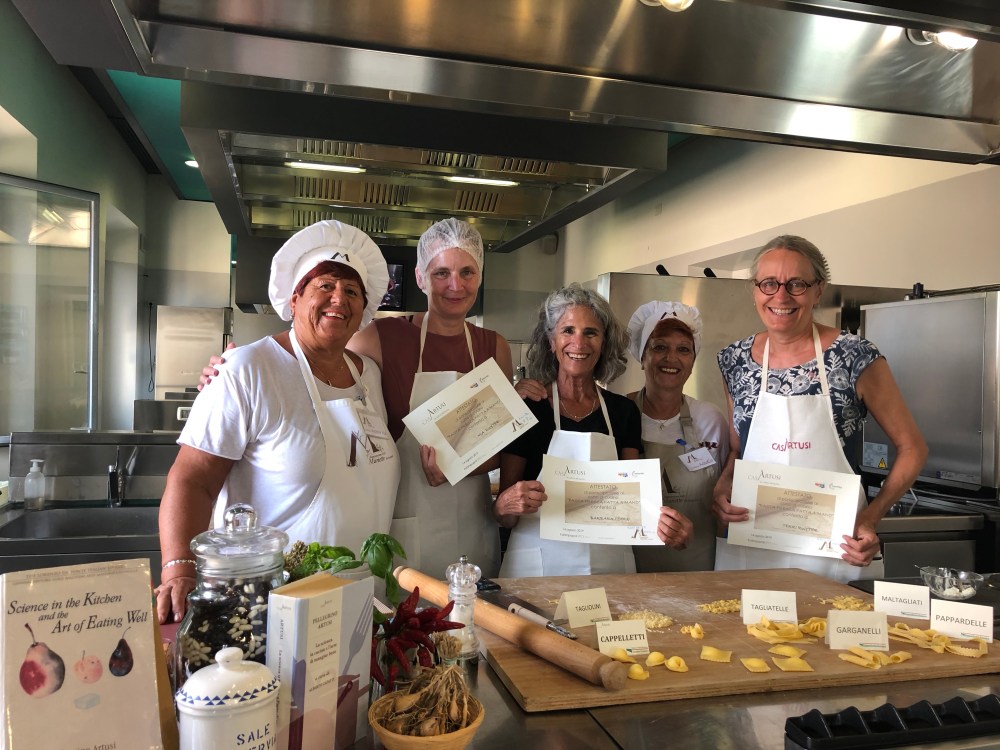
I am on holiday in Emilia-Romagna with friends and family. My sister and a friend (under whose watchful eye I was guided into cooking many years ago) wanted to learn how to make fresh pasta. The host of our holiday rental recommended a cooking class at Casa Artusi in Forlimpopoli. Luckily, they were offering a class on making fresh pasta. We had an interpreter from the center and two Mariettas — Italian women who volunteer their time to share their knowledge of their food – to coach us on how to make a variety of pasta from scratch. (Marietta was the name of the woman who helped Pelligrino test out the recipes without whose assistance the book would not have been completed.)


Basic egg pasta recipe
The basic recipe for fresh pasta is two eggs and slightly less than the equivalent weight of flour – 90-100 grams per egg. The women at the Casa Artusi recommended organic Italian flour of type 0 or 00 and organic, farm fresh eggs. Put the flour on a wooden surface, create a well, and then crack the eggs into the center. Then it is time to get your hands messy. Begin to work the flour into the eggs. Once all the flour is incorporated, you should knead the dough for about 5 minutes. It is done when you gather it into a smooth ball and then it rebounds when you press your finger into it. Let the dough rest for about 15 minutes.
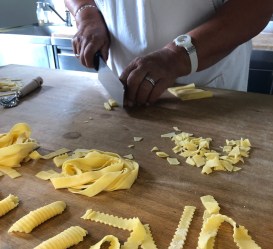
Then comes the fun part of rolling out the pasta with a mattarello (a special rolling pin for pasta) and making the shapes. There were a couple tricks to remember when rolling out the dough. In addition to using a special rolling pin, you can let one edge of the dough hang over the edge of the counter. This holds it in place and gravity assists in stretching out the dough. They also suggested rolling out the dough away from you and giving the dough a quarter turn after rolling in one direction. You should also dust the circle of dough lightly with flour before folding and cutting it to help prevent sticking.
This dough works for any number of pasta shapes – cappelletti, linguine, tagliatelli, etc.
If you do not aspire to become a premier cook, you need not have been born with a pan on your head to become a good one. Passion, care, and the precision of method will certainly suffice; then, of course, you must choose the finest ingredients as your raw materials, for these will make you shine.
I was not born with a pan on my head. And my palate was not any more or less finicky than most children. I do have a passion for food, frequently have a goal of precision of method, and love to shop for fine ingredients. I don’t know if my food “shines,” but I do enjoy my meals. And now that I have learned to make pasta from scratch, I am sure that I will do so more often with greater success. Buon appetito a tutti!
 Principal of Cooking
Yum! I can’t wait to try your delicious pasta! And… I can’t wait to try making it myself!
LikeLike